Hi!
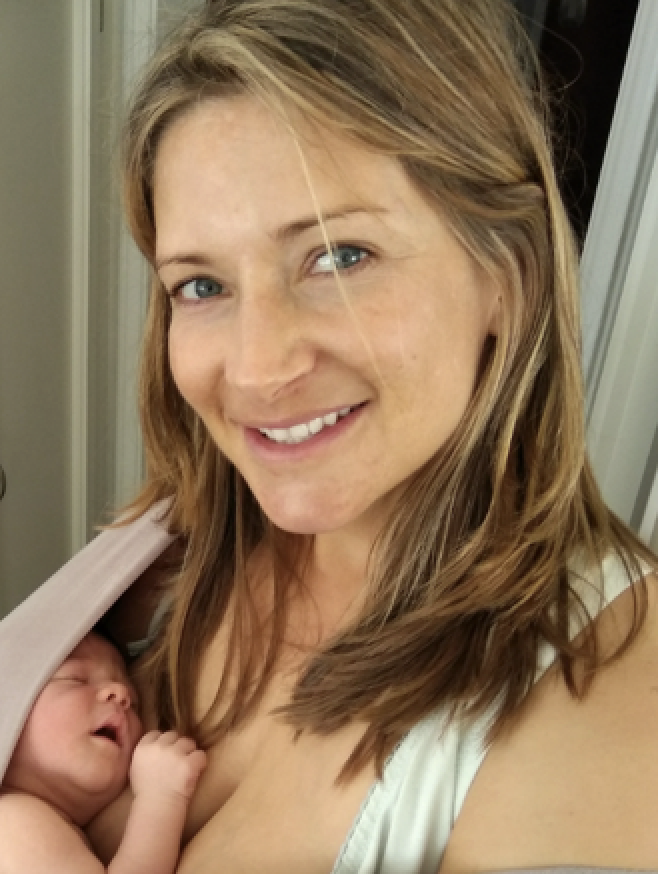
I am an occupational therapist and mother of two. Although I began my profession in clinical occupational therapy, once I had my first baby, who struggled with early movement and could only breastfeed on one side due to torticollis, I was inspired to seek a deeper understanding of how a baby’s brain forms connections through movement, experience, and awareness. That led me to the work of Moshe Feldenkrais, The Anat Baniel Method®, Sylvia Shordike’s NeuroHorizons®, and Craniosacral Therapy. Together, these influences continue to shape, not only how I work with babies today, but how I connect with my own children.
My daughter was born via vacuum-assisted delivery during an emergency C-section, which resulted in significant torticollis. As an occupational therapist I followed the conventional stretching and strengthening techniques recommended by many physical and occupational therapy providers. Despite my best efforts, the stretches were distressing for both of us and my daughter would cry whenever I touched her on her head, neck, and back. Although we worked diligently, her head tilt persisted and her movement patterns remained asymmetrical.
I began to look into different modalities of healing and was introduced to an occupational therapist who was also an Anat Baniel NeuroMovement® practitioner and craniosacral therapist. Her approach was unlike anything I had encountered before. Rather than focusing on stretching and strengthening exercises, she used gentle movement and touch to help my daughter discover new possibilities for comfort, coordination, and ease. Over time, the torticollis resolved, her movements became more symmetrical, and the fear she had developed around being handled dissipated.
When my second child was also born with severe torticollis and breastfeeding challenges of his own, we began working with the same provider immediately, without stretching, and his torticollis resolved much more quickly than my daughter’s.
Witnessing these changes in my own children inspired me to deepen my understanding of the work of Moshe Feldenkrais, the Anat Baniel Method®, NeuroHorizons®, and Craniosacral Therapy. I was fortunate to train with Sylvia Shordike, creator of NeuroHorizons®, and became a NeuroHorizons® Experiential Movement® Mentor.
Today, my work as an occupational therapist is deeply rooted in the non-invasive, movement-based principles that profoundly supported my own children and changed the trajectory of my practice. My goal is not simply to address symptoms, but to support each child’s nervous system, expand their movement options, and help them build the foundation for lifelong learning and development.
NeuroHorizons® Experiential Movement®
NeuroHorizons® Experiential Movement® is an innovative approach developed by Sylvia Shordike and inspired by the work of Moshe Feldenkrais. Through gentle touch and individualized movement experiences, it engages the brain’s natural capacity to learn, adapt, and develop. Grounded in the principles of neuroplasticity, these lessons create new pathways in the brain and help children discover new possibilities for unrestricted movement, feeding, coordination, regulation, comfort, and overall development through increased awareness and whole-body learning, rather than exercises or symptom-focused interventions.
Craniosacral Fascial Therapy
(Gillespie Approach)
Craniosacral Fascial Therapy (CFT), developed by Dr. Barry Gillespie, is a gentle hands-on approach that focuses on releasing tension and restrictions within the body’s fascial system. By addressing areas of compression and strain, particularly those that may result from pregnancy, birth, or physical stress, CFT supports improved comfort, movement, feeding, regulation, and overall function. The work is subtle, non-invasive, and tailored to each individual’s needs.
Safe and Sound Protocol® (SSP)
The Safe and Sound Protocol®, developed by Dr. Stephen Porges and based on Polyvagal Theory, is a listening therapy designed to support nervous system regulation. Using specially filtered music, SSP helps the brain and body become more receptive to feelings of safety, connection, and engagement. It may support improvements in emotional regulation, attention, social connection, sensory processing, and resilience to everyday stress.

Primitive Reflex Integration
Primitive reflexes are automatic movement patterns that emerge in-utero and infancy and serve as building blocks for development. When these reflexes remain active beyond their typical timeframe, they can interfere with gross and fine motor movements, posture, coordination, vision, attention, emotional regulation, behavior, and learning. Through individualized movement experiences and developmental activities, primitive reflex integration supports the nervous system in developing more mature and efficient patterns for movement, learning, and daily life.
New Possibilities Start in the Brain
Whether your baby is experiencing challenges with their movement and milestones, feeding, or regulation it is never too late.
While development follows a natural biological progression, every baby takes their own unique path. Learning to roll, reach, sit, crawl, stand, and walk is a process of exploration and discovery. Between the popular milestones we can easily see, the brain is busy forming up to two million new neural connections every second. Each tiny movement a baby makes helps build the foundation for the larger milestones to come.
A baby’s movement patterns are shaped by many experiences. Challenges during pregnancy or birth or a physical limitation may be part of the story, as well as the everyday caregiving habits we develop. The way we hold, carry, feed, diaper, position, and respond to our babies, along with the time they spend in baby equipment, can gradually influence movement, feeding, sleep, regulation, and their sense of self.
My intention is to help babies discover new possibilities, supporting how they move, learn, feed, and respond to the world with greater flexibility.
I would be honored to support you and your family on that journey.